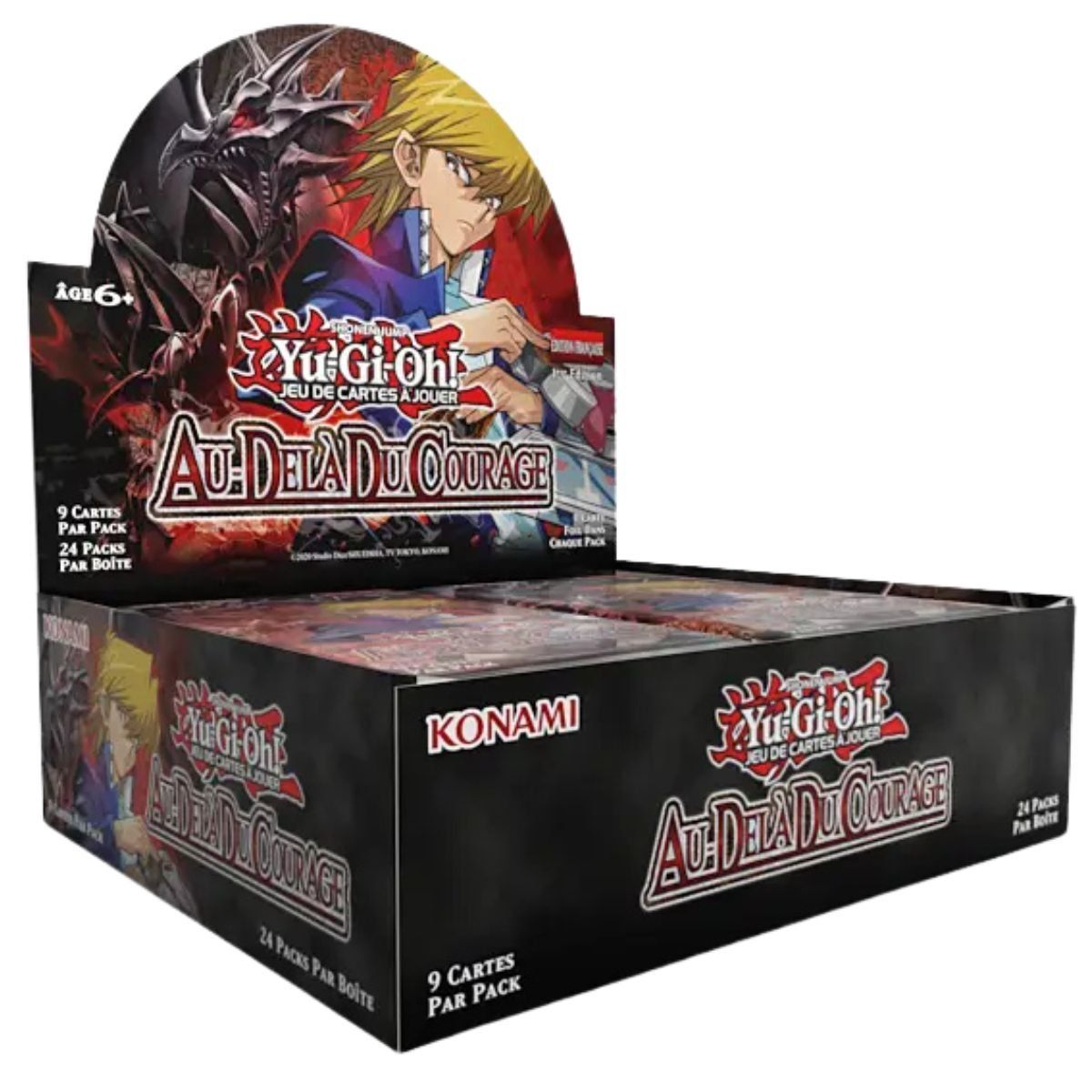
Find our Yu-Gi-Oh! displays with 24 booster packs from recent Konami expansions: Burning Territory, Rarity Collection 5, Blast Protocol, Phantom Revenge, and Master's Labyrinth, in French and English versions.
Opening a Yu-Gi-Oh! booster box is like playing the ninth card lottery: eight common cards plus a guaranteed Super Rare at least, with a one in six chance of drawing an Ultra Rare and a one in twelve chance of getting a Secret Rare. This category includes 24-booster displays from recent sets (Burning Territory, Rarity Collection 5, Blast Protocol, Phantom Revenge, Alliance Instinct) in French and English, supplemented by a few collection expansions.
Yu-Gi-Oh! Trading Card Game, the second major saga of the world's TCG
The Yu-Gi-Oh! Trading Card Game has been published by Konami since 1999 in Japan (where it is known as the OCG - Official Card Game) and since 2002 in Europe and North America. Adapted from the manga by Kazuki Takahashi published in Weekly Shōnen Jump, the game revolves around summoning monsters, the combined use of Spell and Trap cards, and summoning mechanics introduced over the generations (Fusion, Ritual, Synchro, Xyz, Pendulum, Link). The rules have evolved significantly since its launch, but Konami maintains compatibility with the entire historical catalog, subject to the Limited/Forbidden List.
Structure of a modern Yu-Gi-Oh! booster pack
A standard Yu-Gi-Oh! booster pack contains nine cards distributed according to a fixed structure defined by Konami: seven common cards, one guaranteed rare, and a ninth foil card, known as the ninth card , whose minimum rarity is Super Rare. This ninth card is the economic engine of the booster pack: it has a one in six chance of being an Ultra Rare and a one in twelve chance of being a Secret Rare. The Yu-Gi-Oh! collecting ecosystem is built on this distribution: a full display of 24 booster packs statistically promises a balanced distribution between SR, UR, and SCR cards, sometimes with a surprise Starlight Rare or Quarter Century Secret Rare in recent sets.
The Yu-Gi-Oh! rarity system, the most complex of all TCGs
Where Pokémon uses five to six rarity levels and Magic four, Yu-Gi-Oh! uses more than fifteen. The standard range includes Common (C), Rare (R), Super Rare (SR), Ultra Rare (UR), Secret Rare (SCR), Ultimate Rare (UTR) with debossed relief, Ghost Rare (GR) with a full-frame holographic effect, Starlight Rare (ScR) with a complete star pattern, Prismatic Secret Rare (PScR), Collector's Rare (CR), Quarter Century Secret Rare (QCScR) introduced for the 25th anniversary, and Platinum Secret Rare in some sets. Market value follows this hierarchy, with older Ghost Rare cards regularly fetching three- or four-figure prices.
Display 24 boosters: content and distribution
A Yu-Gi-Oh! display contains 24 sealed booster packs , for a total of 216 cards in a standard set. The expected distribution in an average display is approximately 24 guaranteed Rares (one per booster pack), 4 to 6 additional Super Rares , 2 to 3 Ultra Rares , 1 to 2 Secret Rares , and occasionally a card of higher rarity (Starlight, Quarter Century, Collector's). As with other TCGs, these figures are statistical averages: a hot display will far exceed these values, while a cold display will fall short.
The extensions available in our catalog
Blazing Territory (BLZD-FR) explores new Fire archetypes centered around Dragon monsters. Rarity Collection 5 (RA05-FR) is the fifth iteration of the annual set of premium rarity reprints. The Labyrinth of the Dead (MZMU-FR) and The Labyrinth of the Master (MZTM-FR) form a narrative block around the labyrinth theme. Explosion Protocol (BPRO-FR) , Phantom Vengeance (PHRE-FR) , Dimensional Disaster (DOOD-FR) , and Duelist Evolution (DUAD-FR) complete the recent French lineup. On the English side, Battles of Legend: Armageddon (BLAR-EN) is a set of reprints of iconic Ultra Secret Rare cards. Alliance Intuition and Battles of Legend: Monstrous Vengeance (BLMR-FR) are also available.
Banlist and tournament legality: the unique aspect of Yu-Gi-Oh!
Unlike Magic: The Gathering or Pokémon, Yu-Gi-Oh! does not have a Standard format with rotation: all cards printed since 2002 remain tournament-legal, subject only to the Limited/Forbidden List, which is updated several times a year by Konami. This list classifies cards into four categories: Unlimited (3 copies allowed), Limited (1 copy), Semi-Limited (2 copies), and Forbidden (banned from tournaments). This approach allows a player to buy a recent booster pack to obtain cards that will remain playable in five or ten years, provided they do not become Forbidden in the meantime.
Small card format 59 × 86 mm: be careful with sleeves
Yu-Gi-Oh! cards measure 59 × 86 mm , a format known as small or Japanese size . This format differs from the international standard of 63 × 88 mm used by Magic: The Gathering, Pokémon, One Piece, and Lorcana. Sleeves, 9-pocket binders, and deck boxes designed for the standard format are therefore unsuitable for Yu-Gi-Oh!: accessories specifically marked "small size" or "Japanese size" must be used for a proper fit.


 Français
  English
  Deutsch