The official Night City collectible card game, published by WeirdCo under license from CD PROJEKT RED
Cyberpunk TCG, or Cyberpunk CG, is the collectible card game based on Cyberpunk 2077 and Cyberpunk: Edgerunners, published by WeirdCo under license from CD PROJEKT RED. Its Kickstarter campaign raised nearly $28 million, a record for any game.
Three Legends determine the deck's RAM, Eddies are obtained by selling cards from your hand, and you win by collecting seven Gig dice, including those stolen from your opponent.
Set 1, Welcome to Night City, is available as a non-reprintable English Beta edition and as a retail edition, available in French on November 6, 2026.
Cyberpunk TCG: The Official Card Game of Night City
Cyberpunk TCG is the official collectible card game of the Cyberpunk universe. WeirdCo publishes it under license from CD PROJEKT RED, and the game's components are drawn from the Cyberpunk 2077 video game, its Phantom Liberty expansion, and the Netflix anime Cyberpunk: Edgerunners. In France, the game is distributed by Néoludis, designated by WeirdCo as the official distributor for France and the Benelux countries.
The Kickstarter campaign opened on March 17, 2026, with a goal of $100,000. It surpassed $3 million in less than an hour and closed on April 17 with $26,953,978 raised from 47,676 backers. With late pledges from the pledge manager, the total now exceeds $28 million from over 50,000 backers. It is the most funded game in Kickstarter history, surpassing Cosmere Roleplaying Game and its $15.15 million goal in 2024.
The first set is called Welcome to Night City. It was released in English Beta for contributors and partner stores in September 2026, and will be released in Retail on November 6, 2026, with French as the first localization language.
How is the Cyberpunk TCG played?
The game is played by two people, with games lasting approximately fifteen minutes once the rules are learned. Each player needs their own deck and six polyhedral dice: a d4, a d6, a d8, a d10, a d12, and a d20. These dice are included in the starter decks and prerelease kits.
The playing areas
The official playmat defines seven zones. The Fixer Area initially holds the player's six dice, waiting to be taken. The Gig Area receives the dice once rolled: this is the scoring zone. The Field is the terrain where Units are deployed and where combat takes place. The Eddies Area receives the sold cards, placed face down, each worth one Eddie. The Legends Area holds the three Legends, face down at the start of the game. In addition, there is the Deck and the Trash, the discard pile. There is no hand size limit.
The four types of cards
The Legends are the leaders of your crew. You play exactly three of them, each with a unique name, outside of the main deck. They start face down and carry the RAM limit that dictates the entire deck construction.
The Units are the crew members. They arrive on the Field, attack, block, and steal Gigs. They always enter with LAG and therefore cannot attack the turn they are played.
The Programs produce an immediate effect and then go to Trash. Many bear titles borrowed from quests and tracks from Cyberpunk 2077: Nocturne OP55 N1, Pyramid Song, (Don't Fear) The Reaper, The Heist, Bonnie and Clyde, We Gotta Live Together.
Gear is equipped on an allied Unit or a face-up Legend. It grants power and often an effect, and follows the equipped card, even to the Trash if it is defeated. This is where you'll find iconic gear from the franchise: Mantis Blades, Sandevistan, Kiroshi Optics, Gorilla Arms, Satori: Sword of Saburo, Dying Night: V's Pistol, Zetatech Faceplate, Overwatch: Panam's Gift, and The Relic: Experimental Biochip.
The Eddies: every card is also money
There are no resource cards in the Cyberpunk TCG, and no automatic income. Eddies, the eurodollar of Night City denoted €$, come from two places.
The first is selling. Once per turn, you can sell a card from your hand: you reveal it to your opponent, then place it face down in your Eddies Area, where it's worth one Eddie. Only cards with a sell tag, the small €$ symbol in the top left corner, can be sold, and regardless of its cost, a card is only worth one Eddie. In practice, Programs and Gear almost all have this symbol, Units almost never. This is the central tension of deckbuilding: a deck that only plays Units has no economy, a deck that only plays sellable cards has nothing to put on the field.
The second element is Legends. Each Legend in your Legends Area, face down or face up, can be spent for one Eddie. With three Legends, this adds up to three Eddies per turn. Everything resets at the start of the next turn, so Eddies don't accumulate from one turn to the next: your treasury is replenished, it doesn't grow.
The Legends and the RAM
Your three Legends do two things. In part, they serve as your treasury and are revealed one by one. In terms of deck building, they define what your deck is allowed to contain.
Each Legend has a colored border and a RAM value in the top right corner. The rule is simple: a card's RAM value must be less than or equal to the total RAM your Legends provide in that color. Three green Legends with 2 RAM each give you 6 green RAM, thus granting access to all green cards up to 6 RAM. Two green Legends and one red Legend give you 4 green RAM and 2 red RAM: your green cards can go up to 4, while your red cards are capped at 2.
The consequence is clear. A monochromatic deck has access to the heaviest cards of its color. A three-color deck has many options but remains limited to cards with low RAM. RAM is never a factor during the game: it's a ceiling, not a resource.
Flipping a Legend face down is called a Call. It costs one Eddie, once per turn, and it's a blind choice: all three Legends are face down, and the rules forbid looking beforehand. Chance is part of the game, according to the official formula. Once flipped, the Legend triggers its CALL effect, can receive Gear, and sometimes offers activatable abilities. Some Legends have GO SOLO, which allows you to pay their cost to play them directly as a Unit ready to attack, with the risk that they will be permanently removed from the game if they leave the field.
Gig's Dice and Street Cred
A Gig is a contract. It is represented by a die. At the beginning of each round, you take a die from your Fixer Area, roll it, and place it in your Gig Area. You freely choose which die, except for the d20, which is always rolled last.
This choice of order is a real strategic decision. A d4 gives a value between 1 and 4, safe but low. A d20 can give 20 or it can give 1. Depending on your suit, you will want high values, low values, even values, or all different values.
The sum of the visible faces of your dice determines your Street Cred. It doesn't win the game and isn't spent: it's a threshold. Some cards require a minimum Street Cred to activate their effect, or cost less when it's high. Each card imposes its own condition.
The game turn
A turn consists of two phases. The Start Phase takes place in a set order: you straighten all your spent cards, draw a card, then take a die from your Fixer Area, roll it and place it in your Gig Area.
The Main Phase offers complete freedom. You can sell a card once per turn. Summon a Legend once per turn. Play Units, Gear, and Programs by paying their cost. Activate the effects of your face-up Units and Legends. And attack as many times as you have Units ready, which is the major change introduced by the Beta rules: attacking is no longer a single phase at the end of the turn but a repeatable action.
At the start of the game, each player places their three Legends face down, draws six cards, and can make only one mulligan. The starting player spends their two leftmost Legends and does not turn them face up on their first turn, thus negating the first-turn advantage.
The fight
To attack, you expend a ready, lag-free unit by rotating it sideways. Its ATTACK effects trigger. You then choose between two targets: an enemy unit that has already been expended, which provokes combat, or the enemy Gig Area, which triggers stealing.
One rule changes everything: ready Units cannot be attacked. Only those that have already attacked or activated an effect are vulnerable. Attacking, therefore, means exposing oneself, and much of the game is played through this economy of exposure.
The defender then has a React Window, the reaction window introduced by the Beta rules. From this window, they can call a Legend, activate an effect, or play a Program with the QUICK keyword, and use a BLOCKER to redirect the attack to one of their Units.
A fight is resolved by a simple comparison of strengths. The stronger destroys the other; a tie destroys them both. There is no damage, no lasting injury, no hit points. A defeated Unit goes to the Trash with the Gear it was wearing.
A steal yields one die per attack, plus one additional die for every 10 points of power. A Unit with 6 power steals one Gig, a Unit with 12 steals two, and a Unit with 21 steals three. A Unit with 0 power steals none. The attacker chooses which die(s) to take. An attack redirected to a BLOCKER steals nothing, even if the blocker loses the fight: this is the game's primary defensive tool.
Win the game
You win if you start your turn with seven or more Gig dice in your Gig Area. Since each player only has six dice, it's impossible to win without stealing at least one. This is the core design choice of the Beta rules, which prohibits passive play: under the Alpha rules, winning with six dice allowed you to win without ever attacking.
After the seventh turn of the last player, the game goes into Overtime: as soon as a player holds the majority of the dice in play, he wins immediately.
There is one alternative way to lose: if you have to draw a card and your deck is empty, your opponent wins immediately. There is no other way to win, no damage to the player, no life points.
Keywords
The game intentionally includes few of them.
LAG: A Unit with LAG cannot attack or activate any effect that requires expenditure of mana. All Units enter the game with LAG until the end of the turn.
ADRENALINE: This Unit can attack the turn it is played.
BLOCKER: When an opposing Unit attacks, you can spend that Unit to redirect the attack to it.
QUICK: this effect or Program can also be played in reaction, during the opponent's attack.
GO SOLO: Pay the cost of this Legend to play it as a ready Unit, capable of attacking immediately. If it leaves the field, it is removed from play.
Alongside these keywords, four triggers govern the effects: PLAY when the cost is paid, CALL when a Legend is flipped, ATTACK when a Unit attacks and before resolution, DEFEATED when a card is defeated.
The four colors
The game doesn't have factions in the traditional sense. It has a four-branch Color Tree, each branch based on a way of manipulating the values of its Gig dice. This is the game's true defining characteristic, and it's unusual enough to warrant closer examination. Red maximizes , amasses, and crushes. Backed by the Body attribute of Cyberpunk 2077, it rolls its big dice early, seeks the highest possible Street Cred, steals high-value Gigs, and wins through brute force and direct destruction. Adam Smasher: Ender of Legends and Johnny Silverhand reside there. Green aligns , gathers, and executes. Backed by Reflexes, it seeks to form pairs of identical Gig values, aligns its dice values with the power of its Units, forces the opponent to spend their Units, and then destroys those that are spent. It is also the color that calls its Legends earlier. The Arasaka and the Aldecaldos Nomads dominate it. Blue minimizes , hacks, and disables. It's the color of netrunning, programs, and braindances. It plays against the grain: it rolls its dice first and deliberately reduces its own Gig values to activate low Street Cred effects, temporarily disables opposing units, or removes them permanently. The Voodoo Boys, the Mox, Alt Cunningham, and Judy Álvarez are right at home here. Yellow diverges , equips, and recycles. It adjusts its Gigs up and down so that each value is unique, and it's the specialist color for Gear, with sub-themes of sacrifice and recovery. Maelstrom, Trauma Team, and the Heywood ripperdocs all find common ground there.
A notable design feature: corporations and gangs are not tied to a single color. Arasaka is intentionally represented in red, green, and yellow, depending on the character. The color describes a playstyle, not an allegiance.
Build a deck
A Constructed deck consists of exactly three Legends with unique names, excluding the main deck, and 40 to 50 cards in the main deck, with a maximum of three copies of each card. The RAM constraint described above determines which cards are legal. There is no hand limit, and no sideboard rules have been published to date.
Two practical guidelines circulate among players in the early tournaments: aim for at least 30% of cards with the sell tag to avoid being economically stifled, and at least four Units with BLOCKER to avoid being stripped of your Gigs.
A useful clarification regarding unique names: two printings of the same character have different full names. Goro Takemura: Vengeful Bodyguard and Goro Takemura: Hands Unclean are two separate cards, and there's nothing stopping you from playing both.
The sealed format works differently, and it's the one used for Beta Events and Prereleases. The deck is reduced to a minimum of 30 cards, three Legends are chosen, and most importantly, the two color restrictions are removed: Legends no longer determine playable colors, and card RAM is not a factor. Up to three colors can be freely mixed. The recommended deck composition is around half tradeable cards, with experienced players pushing for 55%.
Drafting is not supported at launch. WeirdCo announced that it will focus the first set on a 1v1 constructed experience, while remaining open to exploring other formats later.
Night City on the maps
The characters of Cyberpunk 2077
V features on three cards corresponding to the three origins of the video game: V: Streetkid, V: Roamer of the Badlands, and V: Corporate Exile. Johnny Silverhand is featured on a Legend Secret Rare, Rocking Renegade, and a Unit Epic Rare, Never Stop Fighting. Jackie Welles appears three times, including on Ride or Die Choom, illustrated by Ilya Kuvshinov.
Around them, the set brings together almost the entire cast of the game: Judy Álvarez, Panam Palmer, Goro Takemura, Saburo, Yorinobu and Hanako Arasaka, Adam Smasher, Alt Cunningham, Evelyn Parker, Rogue Amendiares, River Ward, Viktor Vektor, Royce, Dum Dum, Misty Olszewski, Kerry Eurodyne, Dexter DeShawn, T-Bug, Meredith Stout, Placide, Maman Brigitte, Wakako Okada, Padre, Lizzy Wizzy, the taxi AI Delamain, Sandayu Oda, and Saul Bright. Phantom Liberty and the folklore of Night City provide some memorable Units like La Llorona: Ghost of the Past and El Sombrerón: La Venganza Lenta.
The characters of Edgerunners
The Netflix anime is sparingly represented in the first set, and that's a point worth noting for a collector. Only one of its characters appears in the main series: Sasha Yakovleva, a member of Team Maine, who is one of the four Secret Rares in the set under the name Won't Let You Down.
Rebecca, Lucy, and David Martinez exist as cards, but only as Nova Rare promos, never in booster packs. Rebecca: Having a Moment was distributed at convention demonstrations at Anime Expo, Japan Expo, Gen Con, and Spiel Essen, with a second full-illustration foil version by Pandart Studio for the digital celebration on September 4, 2026. Lucyna Kushinada: Fresh Beginnings and David Martinez: Built Different were unlocked at the Kickstarter stretch goals of $15 million and $20 million, respectively.
The second set will focus on Edgerunners. WeirdCo is targeting the first quarter of 2027 and is already working simultaneously on sets 2 and 3, in coordination with CD PROJEKT RED's content calendar. Future sets will not be released via Kickstarter, as the publisher has announced its intention to reserve the new releases for its retail network.
Gangs and corporations
The cards bear tags that identify their faction affiliation. These include Arasaka, Militech, Zetatech, NetWatch, Maelstrom, the Valentinos, the Voodoo Boys, the Tyger Claws, the Animals, 6th Street, the Mox, Trauma Team, the NCPD and its MaxTac, the Aldecaldos Nomads, and the Wraiths. Alongside these factions, role tags run across the colors: mercenary, ganger, netrunner, fixer, rocker, ripperdoc, techie, solo, nomad, samurai, cyberware, weapon, braindance, and quickhack.
The equipment
The Gear set features the chrome design from the video game. Mantis Blades is the most cost-effective card in the set, at 1 Eddie for 2 power, with no rules text. Sandevistan rightes your equipped Unit or Legend at the end of your turn, making it untouchable and restoring its action. Overwatch: Panam's Gift, an Epic Rare, lets you discard a card to destroy an opponent's spent Unit whose cost doesn't exceed the discarded card's cost, and does so in reaction thanks to QUICK. The Relic: Experimental Biochip, also an Epic Rare, replays a Unit from the discard pile for free when the equipped card is defeated, then returns it to the bottom of the deck. Other additions include Kiroshi Optics, Gorilla Arms, Satori: Sword of Saburo, Dying Night: V's Pistol, Zetatech Faceplate, Zetatech Berserk, NetWatch Netdriver, Riot Shield, and Tetratronic Rippler. The two iconic katanas, Modded Muramasa and Modded Kusanagi, are Units and not Gear.
The illustrators
WeirdCo has done a real job of artistic casting, and that's a selling point in its own right.
Ilya Kuvshinov, the Russian illustrator based in Japan, character designer of Ghost in the Shell: SAC_2045, signed two of the four Secret Rares in the set, Panam Palmer: Strength Through Family and Judy Álvarez: Nothing to Doubt, as well as Jackie Welles: Ride or Die Choom.
Michał Dziekan illustrates Adam Smasher: Ender of Legends, the set's showcase card. Daniel Valaisis is the most represented artist on the Legends cards, with Johnny Silverhand: Rocking Renegade, Goro Takemura, Hanako Arasaka, Jackie Welles: Mama's Favorite, River Ward, Alt Cunningham, and Evelyn Parker. Łukasz Poller designs Sasha Yakovleva, Dum Dum, Panam Palmer: Nomad Cavalry, and Johnny Silverhand: Never Stop Fighting. Olgierd Ciszak creates V: Streetkid and Rogue Amendiares: Preem Solo.
Vincenzo Riccardi is the only artist to have been interviewed on the official blog. He created the Arasaka triptych of box toppers, three illustrations designed to fit together into a single image. André Lima Araújo and Chris O'Halloran, a duo from the American comics scene, created Caliber: Totentanz's Top Dog. Toni Infante created the Iconic Rare for Adam Smasher: Metal Over Meat.
On the studio side, Pandart Studio produced all eighteen Legend Iconic Rares for the Beta print run, giving this block a consistent visual style, while Divebound Studio created the four Secret Iconic Rares. Mooncolony, Dardo Studios, Envar, ADIA, Bad Moon Studio, and TOPDOG Entertainment share a large portion of the set's production. A few cards, including Sandevistan and Lizzy Wizzy: Delicate Weapon, are credited to CD Projekt Red: these are illustrations taken directly from the video game.
Rarities and collectibles
The rarity scale increases in five steps within booster packs: Common, Uncommon, Rare, Epic Rare, and Secret Rare. Welcome to Night City contains 60 Commons, 32 Uncommons, 32 Rares, 12 Epic Rares, and 4 Secret Rares, for a total of 140 mechanically unique cards.
Above these are two categories that are not gameplay rarities but rather illustration variants. Iconic Rares, of which there are 31 per print run, are alternative artwork versions of existing cards, with identical rule text. Nova Rares never leave booster packs: they are the box toppers for displays, convention promos, and Kickstarter stretch goals. WeirdCo has committed to never printing mechanically unique promos, which guarantees that no inaccessible card will negatively impact competitive play.
The only metal cards in the set come from the Kickstarter Beta Box, not from booster packs.
Beta and Retail: Which Print Run to Buy
The 140 playable cards are identical in both sets, and a Beta card is tournament legal just like a Retail card. The choice therefore comes down to three criteria.
Language first. The Beta version is only available in English and will never have a French version. The Retail version will be released on November 6, 2026, with French as the first localization.
Next, the packaging. The Beta display contains 36 boosters and a box topper, with a suggested retail price of $180 and a French market price of around €210-€220. The Retail display will contain 24 boosters, with a suggested retail price of $119.90 and French pre-orders priced between €129 and €140.
The collection is finally here. The Beta cards feature a Beta symbol under the RAM icon and a β prefix in their official numbering, and their 31 Iconic Rares have artwork that retail players won't be reusing. WeirdCo announced it would never reprint a set in the same configuration, and the retail order window closed on May 1, 2026. Conversely, no print run figures have ever been published, and the publisher maintains an explicitly anti-speculative stance, guaranteeing retailers their full orders. The Beta's rarity is real, but it stems from its closed configuration, not from an artificial shortage.
Organized play
WeirdCo has announced a four-tiered competitive structure. Retail events are called Night City Gauntlet and Night City Brawl, the latter being weekly starting with the Retail Prerelease. Above these are the regional Edgerunner Opens, announced for the Welcome to Night City cycle, followed by the invitational Black Sapphire Invitational Championships, and finally the Cyberpunk TCG World Championship. Tournaments are held on the Melee.gg platform, with mandatory linking of the player account to their CyberpunkTCG.com account. Over 3,000 stores worldwide are registered for the program.
On the European secondary market, Cardmarket has been the official partner of the game since August 2026.
The calendar
Kickstarter campaign from March 17 to April 17, 2026. Retail orders close on May 1. Delivery to backers begins on September 1, 2026. In-store Beta Events from September 10 to 20. Retail preview the weekend of October 30. Worldwide retail release on November 6, 2026, with a French version. Set 2, focusing on Edgerunners, is targeted for Q1 2027, bypassing Kickstarter.
Where to begin
To discover the game, the most direct way is the set of 2 starter decks The Heist and Embracing Power : two legal constructed decks, six exclusive Legends and the twelve necessary dice, without buying anything else.
For opening cards, the Beta display of 36 boosters is the only product to contain a box topper.
The single Beta booster allows you to test the set without commitment, with 12 cards including 2 Rare or better.
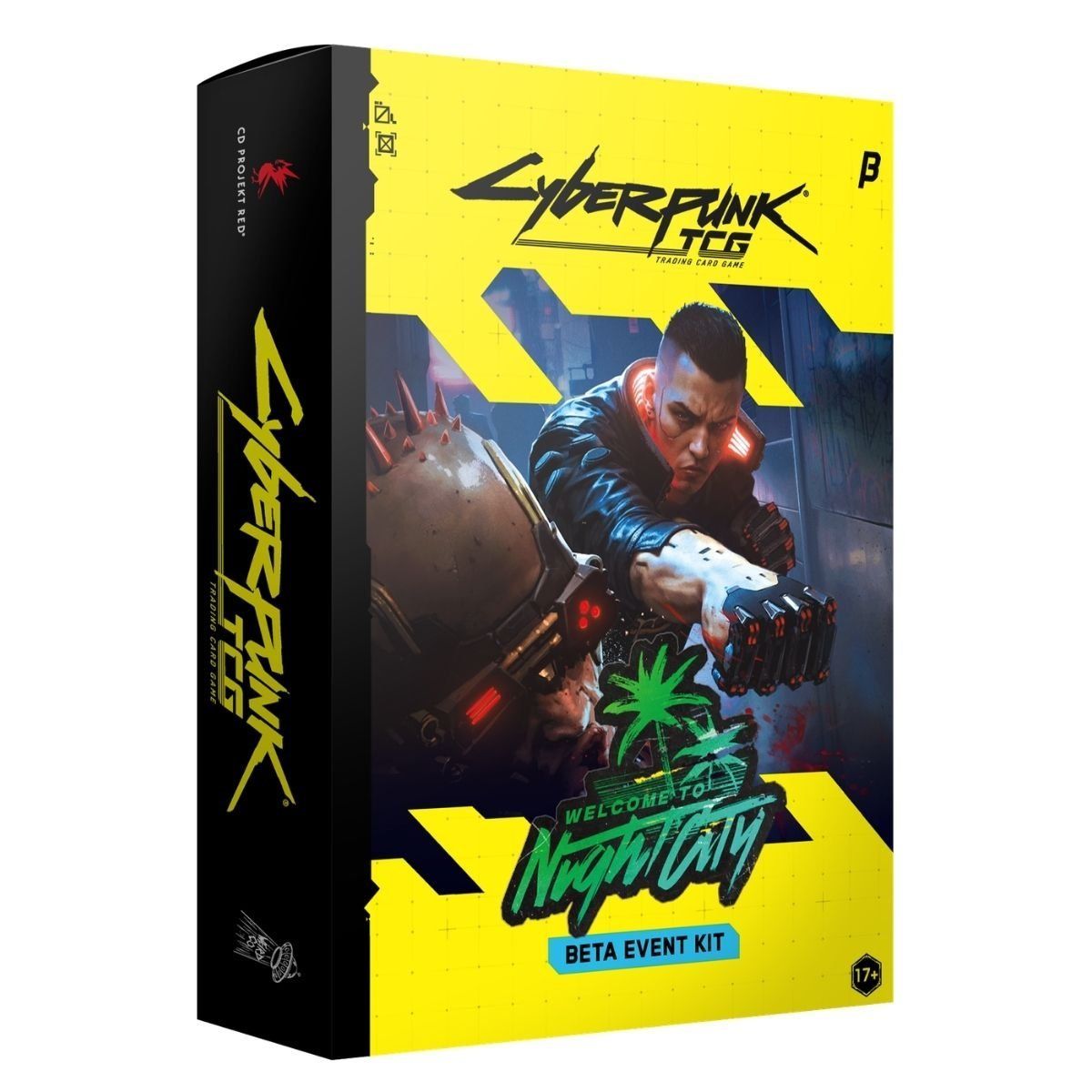
The Beta Event kit includes six boosters, a Mantis Blades promo not available elsewhere, three Legends and a set of polyhedral dice.
All products from the first set are grouped under the category Welcome to Night City - Beta .


 Français
  English
  Deutsch